

Letter from Australia
Judith Mary Jenkins has been living in Brisbane, Australia for the past 20 years or so and here she shares her memories of growing up in Rhossili. (The featured image above is of Rhossili Village Hall prior to its renovation in 2006, reproduced with permission from Pauline Bevan.)
“I thought I would just write a short note about what Rhossili was like during and after the War, when I lived at Great Pitton Farm and I used to spend all my time with my cousins, Ann and Roger Harding, and my brother Christopher, although my father died when Christopher was only 11 years old and after that he used to have to spend most of his time farming. Ann now lives in Western Australia, but Roger and Christopher are still there to keep an eye on things!
During the war there were about 200 people living in the village and I think I had been into every single house. We used to go around collecting for scrap metal etc. during the war, and we also used to get money for the National Savings stamps that we were all encouraged to buy to help the war effort.
We all went to school in Rhossili where we had two teachers; Miss Button taught the ‘little ones’ and Miss Thomas taught the ‘big ones’. Both Miss Thomas and Miss Buttton lived in the village so they knew all about us. I have to say that we had a wonderful education, and I think I learned more at Rhossili School than I did for the rest of the years that I was supposed to be learning. Miss Thomas was particularly keen on Geography and music, and I still remember all the counties in Wales although they have changed many times over the years. We had a Guide group that met in the Village Hall every Friday evening and that was such good fun. I suppose there would only have been about a dozen of us altogether and Mrs Roberts, (the mother of Dora Rosser) who lived in Harepits, was in charge. In the summer we used to go ‘tracking’ around the village, and in the winter we learned useful skills so that we could earn our badges. I was actually underage at the time that I went to the Guides but there was no Brownie group for me to join, so I went to Guides instead.
I remember that in the summer we used to go out to the Boathouse near Worms Head, and jump into the sea. When the tide was in, it must have been very deep and I don’t think I could really swim, but I must have survived, and my mother didn’t seem to worry where we were as long as we were home for our evening meal.
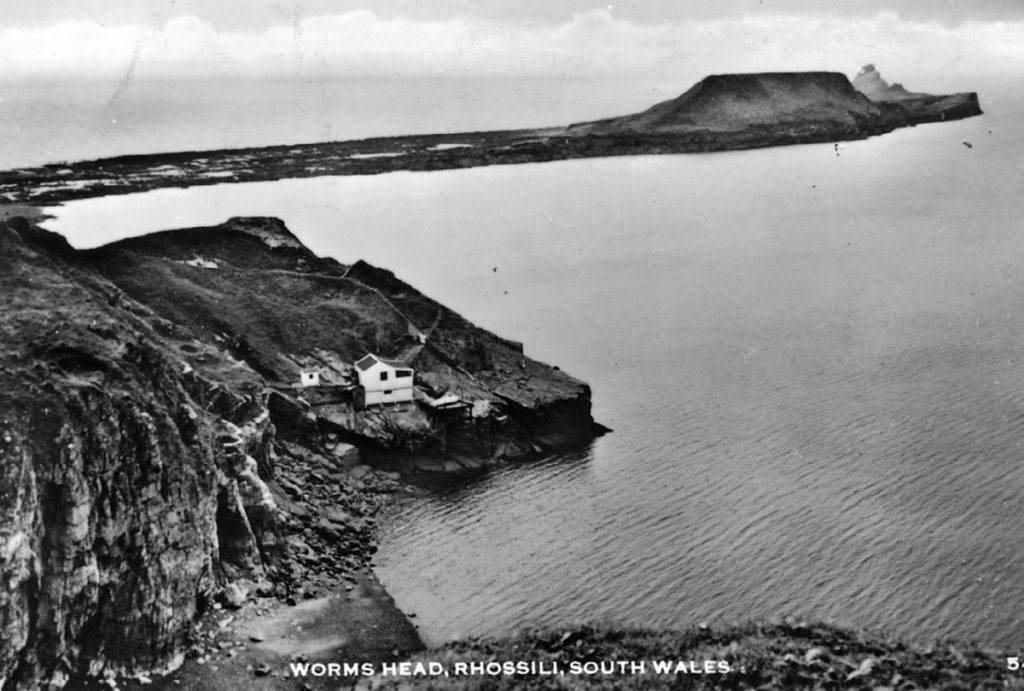
The Boat House, Kitchen Corner. Reproduced with permission from Pauline Bevan
I think that the telephone came to the village in the 1940s. I remember that the Coastguards were Rhosilly 1, the Post Office (which was also the exchange) was Rhosilly 2, Great Pitton Farm was Rhosilly 3, Miss Thomas was Rhosilly 4, etc. And yes, we used to spell the name of the village differently in those days. After being Rhosilly 1,2 3 etc, they became Gower 501, Gower 502 etc, and then Swansea 390501, Swansea 390502 etc until they became 0792501, 0792502, and most recently 01792390501 etc.
During the war, Mansel Thomas lived in Alveley, and you may remember his widow, Gwen, who lived there until relatively recently. Mr Thomas taught German at Bishop Gore School, but his real love was writing plays, some of which were performed on Radio Wales. He wrote a lot of plays that were put on in the Village Hall, and they were wonderful. They were obviously written with the villagers in mind in terms of casting, and the plots were also related to the village. For example, one of them was about the smugglers who used to wreck ships off the coast. They were a great success and involved a lot of people in the village at a time when there was not much entertainment available. Mr Thomas used to produce them and he was an expert!
I think that most people in UK think of Australia as a land of sunshine and beaches. They are not wrong as far as the sunshine goes. But the beaches are nothing to compare with the Gower beaches with the wonderful cliffs, caves, rock pools etc. But I have such happy memories of life in the village and they will just have to suffice.”
Judith Mary Jenkins
From Rhossili Newsletter 2020