

An article by Jack Bevan (pictured above in 1956), published in the Gower Society Journal in 1949.
The sale of the Penrice Estate this year has altered a pattern of life that has existed in south-west Gower since the latter part of the seventeenth century. Our landlords over the centuries, the Franklins and later the Talbots, exerted a remarkable influence over the social life of Gower and they represented a way of life that has been now radically changed by a handshake over an office table between the London valuer and the old tenant farmer, who has now, become almost without exception, his own landlord.
Fortunately Gower has been subjected to this change in the most prosperous period of British farming; this fact, coupled with the generous terms on which the farms were offered to the tenants, has prevented a situation arising in which harshness and greed on one side, and stubbornness on the other could have disrupted the whole community; consequently there is a fairly general feeling of goodwill and understanding. By many of the older people who knew the “Castle” at the height of its glory, and appreciated the personal kindness of its owners, the change is regretted—but the younger ones see in it the march of progress and the opportunity to expand and modernise.
It should be recorded that the “Estate” has been a good landlord. Rents have been low, farm-houses and farm buildings have been kept in a reasonable state of repair and tenancies have been allowed to follow from father to son or to the next-of-kin, if so desired. Interference in methods of agriculture have been unknown, and in general relationships between landlord and tenant have been cordial and established on a firm basis.
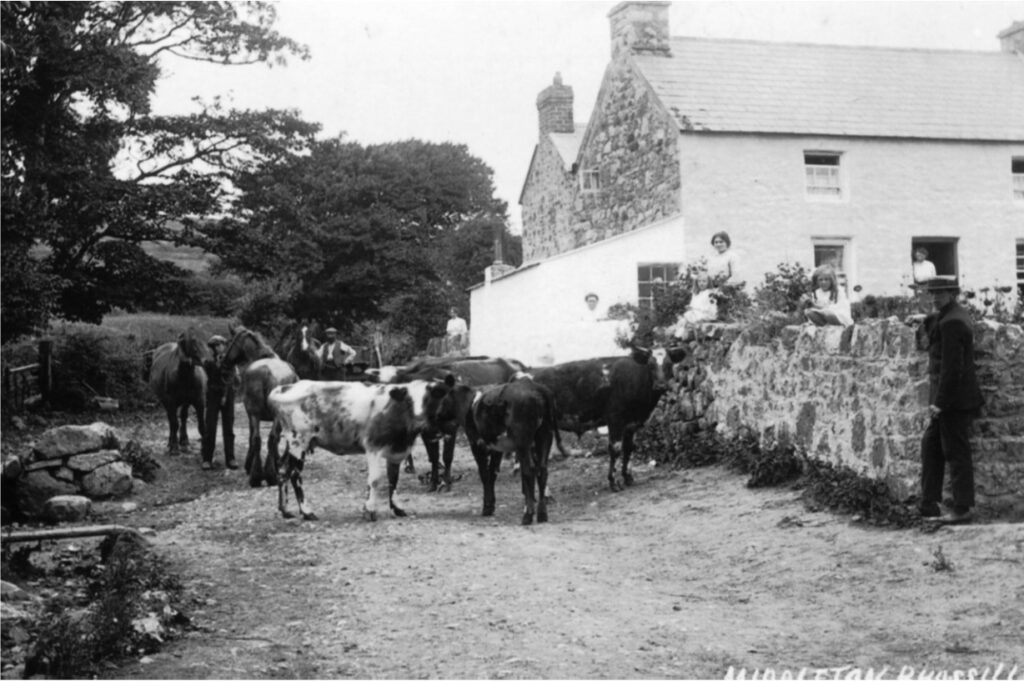
Differences between landlord and tenant, or between one tenant and another were usually amicably settled at the annual court leet, or “leet court” as we called it; here the law of custom prevailed, not the law of the statute book. A tenant could, of course, disagree with the verdict and appeal for redress in the courts of law, but he did not do this lightly, since he placed himself in danger of being given twelve months’ notice to quit his tenancy, unless he could prove that he was the victim of grave misjustice. This may seem a harsh measure, but the jury at the court leet would be comprised of his neighbouring tenant farmers, who would know the contesting parties and the details of the case, before it reached the stage of “taking it to leet court.” The rents were collected half-yearly by the steward and his clerk, in the village hall, or in a hired room at a farmer’s house. If times were hard, a tenant would not be unduly pressed to pay until he sold his beef cattle or his lambs. Rent day was the opportunity taken by the tenant to place his “wants” before the landlord—a new pigsty for one, a stable manger for another, a new parlour window for another, and so on. (Mr. Pritchard the steward once said that he had been asked for more than he had received in rent!) Rents for farmhouse and land averaged between fifteen shillings and a pound per acre, so after paying for repairs there could not have been much left.
“Old Mr. Talbot,” as he was referred to in my young days, was our Member of Parliament for many years until he died in 1890, and his photograph hung, with Mr. Gladstone’s, in nearly every farm and cottage on his estate. He was succeeded at the “Castle” by his daughter, Miss Charlotte Talbot, a stately spinster with a kindly considerate way, especially with the poor ; but her one word was law. One interesting feature of the Talbot family was that they used to graze a flock of wethers on the Worm’s Head from September to March. One was killed every week for their own table; a local farmer was given the job of going out to the Head—between tides every Tuesday—to fetch it to the mainland, where it would be collected by one of the castle servants. It was killed at Penrice, and eaten there if the family was in residence, or, if they were at Margam Castle, or at their London house, it was sent to them in a box made specially for the purpose. They used to call it “Worm’s Head mutton” and boasted that there was none so good, as it had been fed on grass salted by the sea winds. Miss Talbot was the first landlord I remember; she used to visit the day school occasionally in a carriage drawn by two fine horses. Like her father, she used to supplement the parish relief to the poor with two shillings and sixpence a week, or a piece of meat from the butcher’s, as well as allow them to live rent-free.
Although this interwoven personal connection between landlord, steward and tenant worked well, it must not be assumed that tenants had nothing to complain of. For example, the farms were held on a yearly tenancy, but many of the farmhouses were held by the tenant on a three “lives lease.” This was something in the nature of a gamble for the tenant. Our own farmhouse was held on such a lease, on the lives of my grandfather, who built it, my grandmother and my father. My grandmother outlived my father, who died a young man, so the house became the property of the Talbots within forty years after it was built. These leases, the only ones granted at the time, the occasional inequality of the law of custom, and the fear of eviction if caught breaking the game laws, were matters of deep concern to many tenants. However, it was, by and large, a happy community into which I was born, and its tradition has continued to maintain a liberal and peaceful way of life in spite of a turn of events in which the squire, the vicar, and the farmer himself have had no control..
Jack Bremmell (Jack Bevan) J1950
We are grateful to the Gower Society for allowing us to reproduce this article from their1950 journal. Special thanks to Pauline Bevan for giving us a copy of the original article written by her father in 1950 and for giving us permission to use some of the photographs from Jack’s book, Reminiscences of pre-war Gower. Gomer press, 2008.