If you know your Great Tit from your Blue Tit…
Many months ago (well 12 to be exact) the Lady of the Hwb suggested that I write a bird or environmental blog and that perhaps I use the upcoming RSPB Big Garden Birdwatch as a starter. My regular and perspicacious readership will know that I ignored this advice and dilly-dallied long enough to have well and truly missed the BGB by the time I produced the first Reluctant Rhossili Bird Blog (RRBB).
The good news is that this year I am on the ball and ready to kick off 2024 with a special edition[i] of the Reluctant Rhossili Bird Blog announcing the launch of:
The RRBB Big Rhossili Garden Birdwatch
This exciting event will take place between Friday 26th and Sunday 28th January, during which you are invited to spend an hour watching (and recording) the birds in your garden. The event is remarkably similar (identical, in fact) to the RSPB Big Garden Birdwatch which by sheer coincidence takes place at the same time. To take part all you need to do is register at the RSPB site, pick an hour in the designated weekend and then record the birds you see on the RSPB website and also (please!) by leaving a comment listing the same on this blog.
The Rules
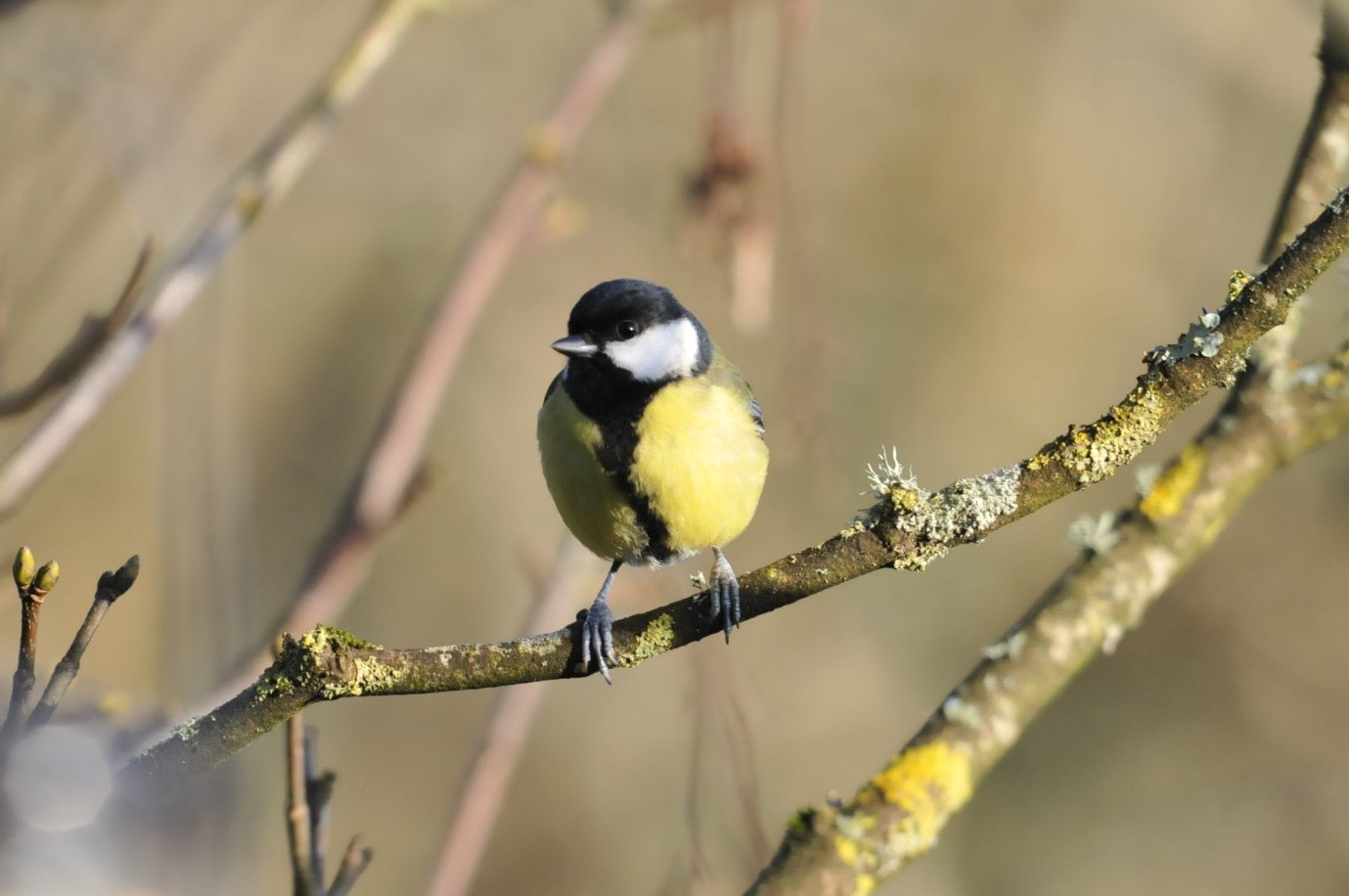
I have a friend (yes, really) who confessed last year that they found the Birdwatch difficult, which surprised me as the rules are quite simple and I was beginning to explain about the rules when she interrupted me to say “Yes, but, how do you tell the difference between a Blue Tit and a Great Tit?” Well dear reader, one of the ways is TO LOOK IT UP ON A BIRD IDENTIFICATION SITE or in a book, or you could just remember that Great Tits, as the name suggests are BIGGER and also (amongst other plumage differences) have a slightly brighter yellow breast than Blue Tits, which in turn are conspicuously bluish and have a brighter yellow breast than Coal Tits, which, unlike Marsh Tits which have a black cap, have a white stripe at the back of what would otherwise be a black cap. And Long-tailed Tits are just little balls of cotton wool with long tails attached. Happy to have cleared that up for you Irene.
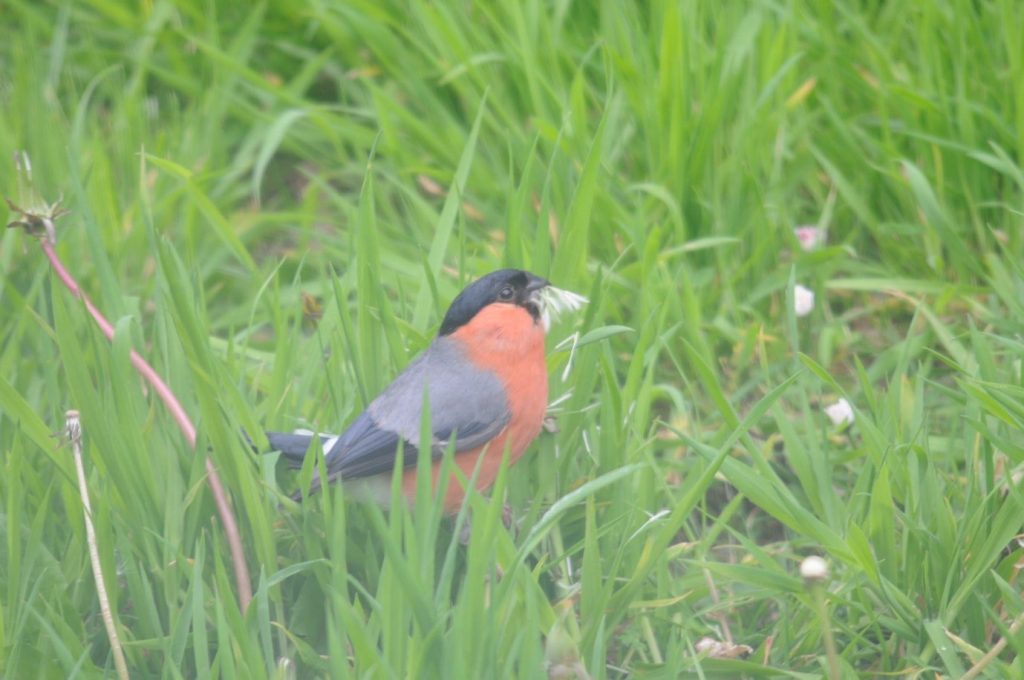
So, as I was saying, the rules are simple. Get a cup of tea, set your timer for an hour and record the birds you see in the garden. Only count birds that are actively using the garden – i.e. have landed in or are hunting over (e.g. Kestrel), not birds that just fly over – and when recording the total number of birds of a species only count the maximum seen at one time (even if you know, for example, because male and female plumages are different, that you saw 2 bullfinches, if you only saw one at a time you only count one). If you use garden feeders make sure they are clean (see below) and full (a perk of signing up with the RSPB Birdwatch is you can get 15% off any bird feed orders at their shop).
And for the RRBB Birdwatch there are just 2 additional rules: the garden must be in the Rhossili parish and your observations must be entered in a comment on this blog (or, if you prefer to remain anonymous, you can email your results to rhossilibirds@gmail.com).

Be a part of the world’s largest garden wildlife survey (and one of the smallest!)
The RSPB Big Garden Birdwatch has been running for 45 years. In 2023 over half a million people took part, counting an impressive 9.1 million birds. Because the survey is repeated at more or less the same time each year it has been able to show distribution trends in certain species, such as Song Thrush which has suffered an 80% reduction since the first watch in 1979.
The RSPB publish the results of the Birdwatch each year giving a breakdown for the UK, for each country and also by county.
The top 13 BGB species counts for the county of Swansea in 2023 are shown below – along with the species count for my garden:
| My Garden BGB 2023 | City and County of Swansea BGB 2023 | ||||
| Species | Count | Species | Mean | % of Gardens | |
| Chaffinch | 8 | House Sparrow | 7.65 | 81.6 | |
| Goldfinch | 6 | Starling | 3.05 | 45.3 | |
| Blue Tit | 5 | Blue Tit | 2.85 | 77 | |
| House Sparrow | 5 | Woodpigeon | 1.79 | 71.1 | |
| Great Tit | 3 | Magpie | 1.66 | 71.9 | |
| Woodpigeon | 2 | Blackbird | 1.63 | 77.9 | |
| G.S. Woodpecker | 2 | Jackdaw | 1.53 | 39.5 | |
| Nuthatch | 2 | Robin | 1.51 | 88.7 | |
| Blackbird | 1 | Goldfinch | 1.25 | 25.7 | |
| Coal tit | 1 | Great Tit | 1.16 | 46.9 | |
| Marsh tit | 1 | Long-tailed Tit | 1.15 | 29.6 | |
| Dunnock | 1 | Collared Dove | 0.94 | 39.4 | |
| Robin | 1 | Dunnock | 0.89 | 43.2 | |
Unsurprisingly the RSPB don’t publish results at parish level, which is where our very own Rhossili BGB would be helpful! For example, following their dramatic and continuing decline since 2005[i] (caused in part by a disease spread from garden bird feeders) I haven’t recorded a Greenfinch in the garden since 2017 whereas 20 years ago they were one of the commonest garden birds.
Greenfinches were recorded in just 6.6% of Swansea gardens in the 2023 Big Garden Birdwatch. It would be very interesting to see if other people get Greenfinches in their gardens and to see the variation in counts of all the different species across the parish. Do you get Starlings or Jackdaws in your garden? I don’t, but they are in the top 10 BGB recorded species in the county. What is the commonest garden bird in the parish? Does Pitton have more and ‘better’ birds than Middleton and Rhossili (probably, but only a rigorous scientific survey along the lines suggested will provide the answer!)1?
So, if you know your Great Tit…

…from a Blue Tit,

please take part in the 2024 RRBB Rhossili Big Garden Birdwatch and be the first to post your observations in the Comments below (or email rhossilibirds@gmail.com)!
Francis Morgan
[i] BTO data on the decline of Greenfinch in Wales:

The smoothed trend line shows how the number of birds has changed through time. To make it easier to compare among species, this is expressed as an ‘index’, set to 100 in the penultimate year. An easy way to interpret this is to say for every 100 birds present now, the trend line shows how many were present in a previous year. The shaded area shows uncertainty around the trend line (based on 85% confidence limits) and values for individual years are shown as dots.
[i] The next ‘proper’ edition of the RRBB will be looking at the areas in the parish that are designated for the protection of wildlife, what these designations mean and how successful the protections are in practice.
- Editor: Of course we have more and better birds in Pitton than Middleton and Rhossili! ↩︎
Sam & I will definitely be doing the
Rhossili Garden Birdwatch.
Looking forward to seeing the results.
Sue
Excellent – thanks Sue – that will be at least 2 returns for Pitton then.
Well and ours. So that’s 3. Yay, Pitton’s winning!
Evening all.
Bird food always out. 8 am till 9 am
Robin 1
Blue tit 4
Great tit 1
Robin 1
Dunnock 1
Wren 1
Song thrush 1
Magpie 1
House sparrow about 11 could have been more
We have a flock of house sparrows living in the garden.
Usually see coloured dives but not today.
Usually see a grey wagtail and pied wagtail but again absent today.
Very good – thanks very much Sue. Was the double robin entry an accident, or 2 robins or a different bird?
Broad Hay will be bird watching so that’s one for Middleton this weekend.
Very good – thanks Barrie
Windy Ridge, Pitton:
Bird food put out – yes. 10:30 – 11:30 26th Jan.
Blue Tit – 6
Long Tailed Tit – 4
Coal Tit – 2
Great Tit – 2
Chaffinch – 4
Great Spotted Woodpecker – 2
Nuthatch – 1
House Sparrow – 1
Robin – 1
Bullfinch – 1
Pheasant – 1
Dunnock – 1
Woodpigeon – 1
So, same number of species as last year (13), but slightly different list, but only 27 birds in total, 11 fewer than last year. Odd not to get a Blackbird (there were 2 just before I started the count!) and I haven’t seen last year’s Marsh Tit since August, so not surprised not to see it this year!
‘Best’ bird – glorious male Bullfinch. (there was also a female, but I couldn’t count her as I didn’t see the 2 together.)
Best bird not counted: heard but NOT in my garden – Tawny Owl hooting, possibly at Bunkershill …
Hi Francis
Just completed the birdwatch in my garden.
So delighted to see one thrush!!!
Others were:
2 blue tits
2 great tits
12 house sparrows
1 dunnock (I think)
1 robin
That’s great thank you Vicky. Do you know if the Thrush was a Song Thrush or a Mistle Thrush? Song Thrush is slightly smaller and prettier – and the one most likely to be in a garden …
Hi Francis
I looked at a short video about how to identify one from the other and am still undecided. I wouldn’t say it was particularly small and pretty but it wasn’t greyish either. So, on balance, maybe say Song Thrush?
Vicki x
Sounds good to me Vicki!
Bunkershill, Pitton
11:30 – 12:30 28th Jan
Birds Fed? – not sufficiently to attract any actual birds!
Blue Tit – 3
Great Tit – 2
Woodpigeon – 2
Robin – 2
Blackbird – 1
Magpie – 1
Best non-countable birds, pair of choughs and pair of raven flying over … Song Thrush singing repeatedly in the hedge, just outside the garden!
Here are the results of the Pitton Mill jury:
House sparrow 7
Chaffinch 7
Blue tit 6
Great tit 4
Robin 4 (there was plenty of food for everyone, but no, they just wanted to fight over it)
Coal tit 2
Goldfinch 2
Blackbird 2
Magoie 1
Wood pigeon 1
Dunnock 1
Great spotted woodpecker 1 (I actually saw a male and a female, but not at the same time. let’s hope they’re nesting again!)
Nuthatch 1 (again, saw two different ones, but not together)
I didn’t see any long-tailed tits in the hour. We also regularly see wrens in the garden and Tawny owls are common in the trees along our boundary.
Great stuff – thank you Maggie. The ‘Magoie’ is a new species for me, need to look it up …!
Gosh, you know so little Francis. Never heard of the Magoie? Very much of Celtic origin.
Garden Birdwatching 11-15 to 12-15 27th Jan 2024
Middleton
Bl/T. 5
Gr/T 2
H/Sp. 12
Rob. 1
Dunn. 1
Star. 1
S Thr. 1
Chaff. 1
Bl/B. 1
M/Pie 2
W/Pig. 3
J/D. 1
Crow. 1
Linn. 30
Not recorded 40 J/D in our adjoining field
R/Kite. 1 flying over
Buzzard 2 circling above
Linn. >100 flying past
Starling 10 in our distant tree and 4 Crow
Additional 4 W/Pig in our field
That’s quite a list Barrie; thanks very much.
Very grateful to receive the list below from Judy at Hoarstone, from the watch she did on Saturday, ably (?) supported by a 40 year old Reader’s Digest Book of British Birds. I have edited the list slightly to remove one species only found in the UK in Scotland and to substitute a more common species (House Sparrow) for one now quite rare (Tree Sparrow). I have promised Judy that if she proves me wrong I’ll make a public statement to that effect on this blog.
Hoarstone, PItton – 27th January
Birds fed – Yes
Woodpigeon – 2
House (not Tree) Sparrow – 3
Blue Tit – 4
Great Tit -1
Long Tailed Tit – 3
Chaffinch – 4
(Song?) Thrush – 1
Blackbird – 1
Robin – 2
Magpie – 2
Great Spotted Woodpecker – 2
Crow – 2
Jay – 2
Pheasant – 1
Also very grateful to receive the list below from Mike and Lea at Tir Na Nog;
Tir Na Nog, Middleton
28th January – 8:30 to 9:30
Birds fed? – Yes
Great Spotted Woodpecker – 1
Robin – 2
Goldfinch – 9
House Sparrow – 5
Dunnock – 1
Magpie – 1
Long Tailed Tit – 8
Blue Tit – 6
Great Tit – 3
Coal Tit – 1
Blackbird – 2
Dunnock – 1
Results from Ty Capel Pylewell, Pilton Green
We have bird feeders out with sunflower hearts, peanuts and fat balls
House sparrow 10
Blue tit 3
Great tit 2
Chaffinch 4
Robin 1
Wren 1
Magpie 1
Gold finch 7
Blackbird 2
Dunnock 1
Long tailed tit 4
Greater spotted woodpecker 1
Brilliant. Thanks very much Sarah.
At Riverside we saw:
2 blackbirds
5 bluetits
1 chaffinch
2 coaltits
2 collared doves
4 wood pigeons
1 magpie
5 house sparrows
2 male robins
2 great tits
4 jackdaws
And one pesky cat stalking them all!!
Joan
Hi Joan – thanks very much for this. Great you got collared doves on your list. The cat, not so good!
Such a shame about the Greenfinches, perhaps that situation will improve. we do clean our feeders occasionally, but I’ll increase the frequency now that I’m aware of this. Interesting that Nuthatches and GS Woodpeckers don’t feature in the City and County of Swansea BGB 2023.
Thanks for keeping us up to speed with things Francis – a really valuable service. 🙂
Paul