

Isobel Everett is better known locally for her leadership in establishing the Rhossili Covid Support Group during the pandemic, her involvement with Pitton Chapel and the local community choir – and as an enthusiastic glass artist. Not as someone very familiar with muddy trenches or scaling tall buildings! Read on!
Tales of a young female civil engineer in the 1980’s
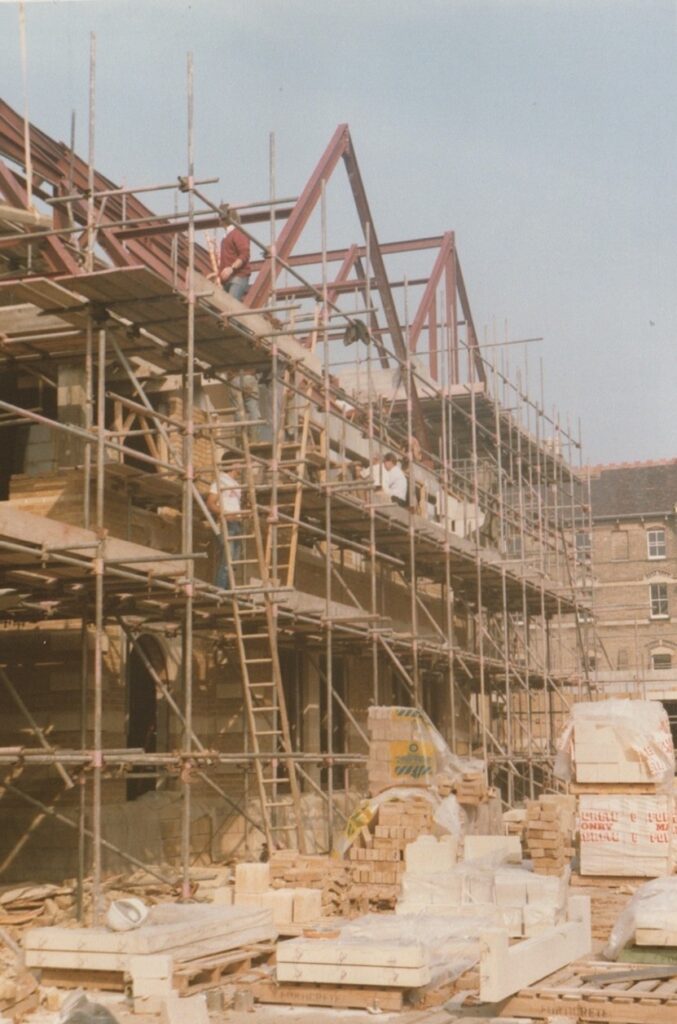
At 21 I ventured out into the big wide world as a graduate of Civil Engineering from Kings College London. I was fortunate back in the early eighties to get employment and a proper training contract which meant, if I worked hard, studied hard and passed the exams I could potentially become chartered at the age of 27. I found the first couple of years challenging. Having to get up and into work on time, understanding office politics, realising I didn’t know much about real life engineering as opposed to the theory at Kings. In particular I remember seniors red-penning my letters when I thought I had a good grasp of the use of the English Language, using razor blades to scrub out mistakes on my engineering drawings by working in haste (using a Rötring ink pen on tracing paper, no quick “undo” button then).

Gradually I was given more responsibility, not only for design work, such as the structural steel design for Exmouth Swimming Pool, but project management of projects more generally, exposing me to risk management, stakeholder management and critical path analysis. All long before anyone ever heard of Prince 2. I spent a year on site in Broxbourne, Hertfordshire building a new civic centre. Living in Chalk Farm, London, I had to set off each morning at 5am to get out there for the 730am start. My social life was rather minimal that year.
I was seconded to Wates contractors, working outside in all weathers with burly blokes all around me. During this year I learned to accept “rude” calendars on the portacabin walls and the fact I had to walk half a mile to a female Portaloo toilet. Maybe I could have tried to use the urinals but a Portaloo was better bet with the 7 layers of clothing I often wore to stay warm! This would not be the case on site now. I also developed a life-long love of bacon and egg sandwiches which has never helped the waistline, and the ability to talk to people of all backgrounds, skills and attitudes.
Building a good relationship with the Foreman was absolutely key; I learned about betting on the horses, how he went to a crematorium and took flowers (several days after the main event) to take to nursing homes to cheer up guests. Listening and showing an interest and respecting their vast practical knowledge helped build respect both ways. Some of my key jobs were checking the formwork and the reinforced steel layout before any concrete pour; then taking samples of the concrete to be tested for strength. Lots of setting out (using a theodolite and level) to make sure trenches were dug in the right places.

Back in the office a year later, I was given the task of writing a computer programme to design the tallest power station chimney in the world at 250 metres (in Matimba, South Africa), under the guidance of the tall chimney expert Geoffrey Pinfold. This was cutting edge stuff at the time and I loved it. (Click on the link to read a paper authored by Pinfold in 1987 about the design and construction of the two 250m high chimneys for Matimba Power Station at https://journals.co.za/doi/pdf/10.10520/AJA10212019_14085.)
However, when I came to review the contract documentation for the build, I was horrified to find two sets of terms and conditions; one for black workers, one for white. The black worker terms were considerably less favourable. What was I supposed to do? How could I influence this situation? I went to my supervisor with my concerns and was politely told that was above my paygrade. This was an early gut reaction which helped me understand what values I hold dear to today. The chimney was successfully built and I believe still in use today.
Similarly above my paygrade was the opportunity to see them for real! Though I did look out for them on a road trip through South Africa in 2012.
Later in 1987 I moved to the United Kingdom Atomic Energy Authority in Oxfordshire to be a project coordinator on a refurbishment project on a highly secure chemical/nuclear research laboratory involving twelve different contractors (with 100 workers) whilst keeping the facility operational. My skills in talking to anybody came into play here, be it liaising with professors of nuclear engineering or electricians about to go into a radioactive area. In my role I ensured appropriate work permits were completed, that every contractor knew the safety procedures. I had to resolve work specification queries, develop and write the waste disposal processes and ensure they were followed and deal with any time/quality conflicts that arose during the work. Whilst all the time keeping track of progress and costing any changes to the contracts.
Apparently, I was rather an unusual specimen at the time and UKAEA wanted to highlight their forward-thinking approach to gender equality. I was chosen to be the subject of some PR material including a picture of me on site. You can see the shot below. What is wrong with it? Well they made me wear a dress so viewers could tell I was female. I argued that there was no way I would wear that to work because of the mud in the trenches. But again, I didn’t sway them. Maybe offering to do some shots in a bikini would have worked? After all that sort of talk was commonplace then! Would I say something now? Definitely, but is that because of stronger values, age or experience, or just a different social culture and expectations? I don’t think these experiences harmed me, just made me think a bit more about society’s expectations and my values. Whatever the dilemmas I had then, I went on to qualify as a Chartered Civil Engineer based on my training and experience at the earliest possible age of 27. And so started another chapter in my engineering life.

I moved to Manchester for 3 years to work for AEA Engineering, an offshoot of UKAEA. I was in business development, writing tenders and pricing contracts and subsequently winning work all over the world for the advanced engineering expertise that had developed within UKAEA. 1990 here I come! I worked for AEA Engineering up until 1996 in various roles before moving into Local Government where I was Group Manager for all the civil, structural, water and airport engineering in Bristol.
Bristol City Council in 1996 was very PC so absolutely no naughty calendars and thankfully female toilets were common place. My next lesson though was to understand and work with the politicians….