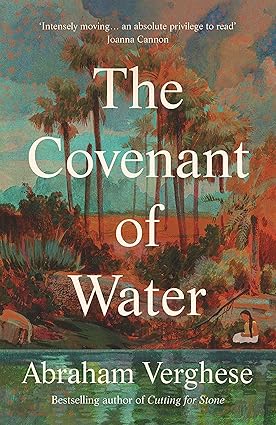
Spanning the years 1900 to 1977, The Covenant of Water follows a family in southern India that suffers a peculiar affliction: in every generation, at least one person dies by drowning – and in Kerala, water is everywhere.
Introduction to the author and book
Abraham Verghese was born in Ethiopia (in May 1955) to Indian parents from Kerala. He moved to America in 1980 to begin his medical residency after graduating from Madras Medical College in India. Prior to this, he temporarily relocated to the U.S. in 1974 after civil war interrupted his early medical studies in Ethiopia.
In 1991, Verghese graduated with a Master of Fine Arts (MFA) in Fiction from the prestigious Iowa Writers’ Workshop at the University of Iowa.
He temporarily stepped away from his medical practice in infectious diseases to pursue this creative writing degree. Shortly after graduating, his short story “Lilacs” was published in The New Yorker, which helped launch his renowned literary career alongside his medical profession.
After graduating in 1991 Verghese returned to medicine, taking a position as professor and chief of the Division of Infectious Diseases at Texas Tech Health Sciences Center in El Paso, Texas. Verghese wrote of his experience fighting the AIDS epidemic in East Tennessee in his first book, My Own Country, published in 1994 to critical acclaim.
In his memoir, The Tennis Partner (1999) Verghese writes of his friendship with a medical student through their shared love of tennis, until the student’s past drug addiction threatens to destroy their bond. This is a New York Times Notable Book.
Verghese’s debut novel, Cutting for Stone (2009) was widely praised and stayed on the New York Times bestseller charts for more than two years. It was translated into more than twenty languages and is being adapted for film by Anonymous Content.
Verghese was awarded the National Humanities Medal by President Obama, has received six honorary degrees, and is an elected member of the National Academy of Medicine and the American Academy of Arts and Sciences. He lives and practices medicine in Stanford, California where he is the Linda R. Meier and Joan F. Lane Provostial Professor in the Stanford University School of Medicine.
A decade in the making, The Covenant of Water (2023) is Verghese’s first book since Cutting for Stone.
It is a sweeping, multi-generational saga set in Kerala, India, spanning from 1900 to 1977. It follows a Christian family plagued by a tragic hereditary mystery: at least one peron in every generation dies by accidental drowning.
The story is woven around two main perspectives:
Big Ammachi: Beginning as a 12-year-old child bride, she moves to the waterside Parambil estate and becomes its resilient matriarch. She and her family survive generational tragedies, changing political landscapes, and the mysterious affliction they call “the Condition”.
Digby Kilgour: A Scottish surgeon who arrives in Madras (now Chennai) in the 1930s. After enduring personal and professional hardships, he dedicates his life to a leprosy colony.
Over the decades, the family tree—which they call the “Water Tree”—is meticulously traced by Ammachi’s granddaughter, Mariamma, who becomes a brilliant physician. Ultimately, Mariamma’s medical investigations uncover the biological root of the drownings (which are revealed to be the result of a specific anatomical anomaly) and piece together the tragic secrets of her ancestry, beautifully connecting Digby’s and the Parambil family’s lives.
‘A shimmering evocation of a lost India and of the passage of time itself, The Covenant of Water is a hymn to progress in medicine and to human understanding, and a humbling testament to the hardships undergone by past generations for the sake of those alive today. Imbued with humour, deep emotion and the essence of life, it is one of the most masterful literary novels published in recent years’. Amazon
‘The Covenant of Water … has the aspirations of an epic; a saga of births, deaths and everything in between happening in cycles. The plot turns on climate catastrophes, diseases and accidents, punctuating the novel’s 10 sections, each calamity tragic, riveting and pivotal to the story’. The Guardian
‘ … grand, spectacular, sweeping and utterly absorbing’ The New York Times
‘At over seven hundred pages, The Covenant of Water deserves the word epic for its reach, ambition and the number of characters and plotlines it weaves together’. Literary Review
‘The Covenant of Water is vast, teeming, multi-layered, harrowing, funny, heartbreaking, and beautiful — much like India’. The Church Times
What do you think of this novel?
Share your comments – but please not until the month is at an end. We don’t want any spoilers! And please remember to follow the Site rules.
We aim to post a book of the month on here at the start of every month, so why not encourage others to read them and get some ‘book’ discussions going on within the community.
Once you’ve read this month’s book, and after the end of AUGUST please, use the comments box below to say what you think about it; what you liked and didn’t like. What about the writing style, pace, mood, characterisation, use of description, the plot … ? Or get in touch with your comments and opinions by email to (rhossilihwb.cymru@gmail.com).
Vicki James & Helen Sinclair
The next book for September 2026 will be …
‘James’ by Percival Everett published March 2024; 320 pages; Amazon 4.5*
Winner of the 2025 Pulitzer Prize for Fiction, James follows Jim and Huck Finn’s dangerous journey along the Mississippi River in 1861, as they flee from slavery and abuse.